
A digital marketing course, a coding bootcamp and a design certification all promise the same thing: a faster route into a well paid, in demand career. Most of them deliver a certificate. Fewer deliver a skill an employer will actually pay for. This guide covers how to tell the two apart across marketing, development and design, and where a counselor makes that judgment call easier than a course catalog ever will.
In This Guide
- Digital Marketing Course: What to Look For Before You Enroll
- Digital Marketing Certification: Is It Worth the Investment?
- Full Stack Developer Course: The Complete Guide
- Coding Courses Online for Beginners
- UI/UX Course: How to Start a Design Career
- Project Manager Course: Certifications That Actually Matter
- Google Certification Courses Worth Taking
- Business Analytics Course: Career and Skills Guide
Why This Field Rewards Careful Choosing Right Now
India's job market added marketing, development and design roles faster than almost any other skills category over the past few years, and hiring in these three fields continues to run ahead of most traditional degree tracks. Industry body NASSCOM has tracked this demand shift for years across the country's technology and services sectors, and Kerala's own IT and services corridor has grown alongside it, creating steady local demand for developers, designers and marketers who can show real project work rather than a transcript alone.
That growth has pulled in a matching flood of low effort course listings, many built to sell a certificate rather than teach a skill. The practical effect for a learner is that the course title tells you almost nothing; the curriculum, the mentor access and the outcome do. Two courses can carry an identical title and produce completely different hiring outcomes six months later, purely based on whether either one included a mentor review cycle and a real project brief.
The Cost of Choosing the Wrong Course
The visible cost of a weak course is the fee. The larger, less visible cost is the time spent completing it and the months that follow spent applying with a portfolio that does not hold up in an interview. A learner who spends four months on a shallow marketing course and then needs another four months of self directed practice before landing a role has effectively paid twice, once in fees and once in delayed income.
This is the specific failure mode a counselor is positioned to prevent. Reviewing a syllabus for genuine depth, checking whether an academy's placement claims hold up, and matching the course level to where a learner actually stands today all happen before enrollment.
Marketing Track: What Separates a Real Program from a Listicle Course
A marketing program worth its fee teaches paid search, organic search, social and email as connected disciplines, not four unrelated modules bolted together. It should require you to plan and execute against a real or simulated budget, since reading about a channel and allocating spend across it are different skills entirely. Google's own certification tracks and HubSpot's free coursework are reasonable starting references for what a channel specific curriculum should actually cover, even if you ultimately enroll through a Totedz listed academy rather than either platform directly.
Watch specifically for courses that spend most of their runtime on terminology and theory and very little on live tool access. A marketer who has never opened an actual ads dashboard before their first job interview is at a real disadvantage against one who has, regardless of how many slides either of them sat through.
Development Track: Why Deployment Skills Are the Differentiator
Most beginner development courses teach syntax well and deployment badly, if at all. A learner can finish a respected course able to write working code that never leaves their own laptop, which is a meaningfully different skill from shipping something a stranger can visit at a real URL. Employers screen for the second skill far more than the first, because it signals the candidate has actually operated inside a real development workflow.
Git version control, basic hosting, and at least one deployed personal project are the minimum bar a serious course should clear before calling itself job ready. If a curriculum's final module is a quiz rather than a deployment, treat that as a warning sign rather than a technicality.
Design Track: Portfolio Over Certificate
Design hiring runs almost entirely on portfolio review, more so than marketing or development. A design course's certificate carries little independent weight; what matters is whether the course forced you to produce three or four polished, presentable case studies along the way, each documenting a real problem and your reasoning, not just a final screen.
This is also where a counselor's outside perspective is most valuable, since it is genuinely difficult to judge your own portfolio's readiness. A short review call before you start applying often catches gaps a learner cannot see in their own work.
How a Marketplace With Counselors Differs From a Plain Catalog
A course catalog site lists options and lets you guess. Totedz pairs every learner with a counselor who has actually reviewed the academy, the syllabus and the placement record behind a listing, then matches it against your specific goal, whether that goal is a first junior role, a freelance income stream, or a lateral move from a non technical background into a full stack developer track. That review layer is the part a search engine result page cannot replicate.
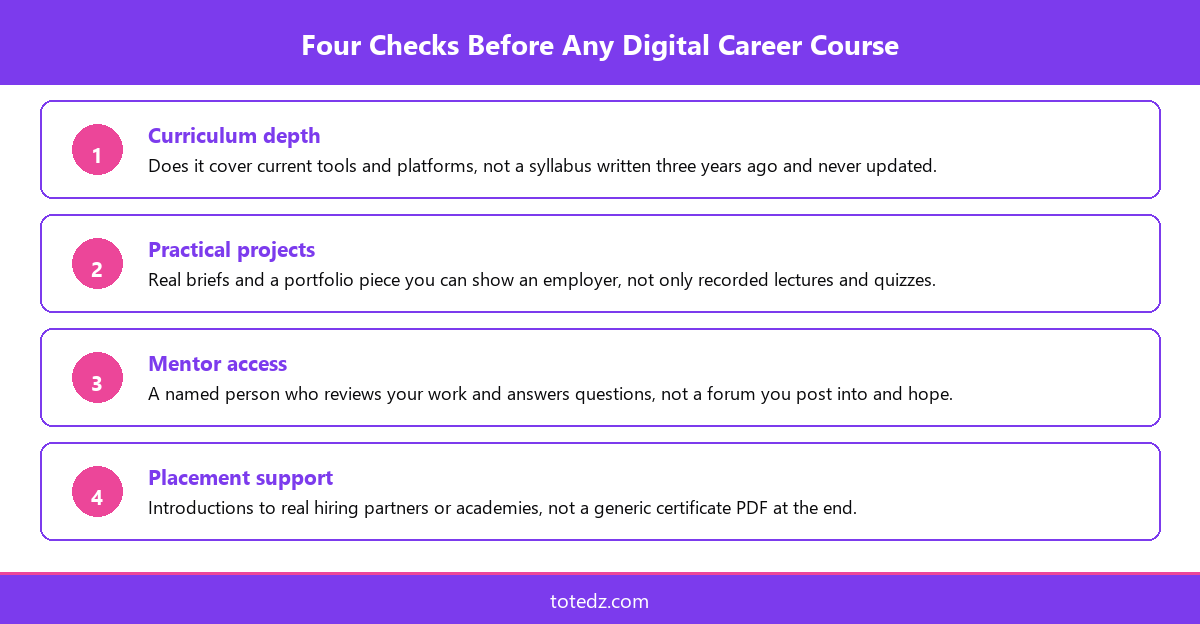
A Decision Framework Across All Three Tracks
Marketing, development and design courses fail learners in the same four ways: thin curriculum, no hands on project, no mentor feedback loop, and no placement pathway. Before comparing specific programs, run every option through those four checks. If a listing cannot show you a syllabus, a sample project brief and a named point of contact for questions, treat the certificate at the end as decorative rather than functional.
For marketing specifically, look for a program that goes deep on one or two channels rather than a shallow survey of ten. For development, check whether the course teaches deployment and version control, the part most beginner tracks skip; our full guide to evaluating a coding education covers this in detail. For a certification heavy option, weigh it against what a certificate alone can and cannot prove before paying for the badge.
Where These Skills Actually Lead
Marketing, development and design rarely stay separate in practice. A designer who understands basic HTML ships faster. A marketer who can read analytics code moves into growth roles sooner. A developer with a certification in project management often becomes the technical lead by default. Choosing one course does not close the other two doors, and the strongest career paths on Totedz tend to combine at least two of these three skill areas within three to five years.
If your interest leans more toward data and automation than campaigns or code, the adjacent skills in our AI and data careers guide cover the analytical side of this same shift, and a counselor can help you decide which side to start on based on where you are today.
Budgeting Time as Carefully as Money
Most comparison guides focus entirely on course fees and skip the time budget, which is usually the bigger constraint for working adults and students juggling other commitments. A marketing or design course with a lighter weekly load but a longer overall timeline can suit a full time employee far better than an intensive program that promises faster results but assumes ten or more free hours a week, which few working learners actually have on a sustained basis.
Ask any academy directly how many hours per week their stated timeline assumes, and compare that honestly against your actual schedule rather than an optimistic one.
If You Are Undecided Between the Three Tracks
Indecision between marketing, development and design is common, and it is rarely resolved by reading more comparison articles. It is resolved faster by a short project in each direction: write and run one small ad, build one static page, or redesign one screen of an app you use daily. Whichever task holds your attention past the first hour, rather than feeling like a chore, is a far more reliable signal than any aptitude quiz.
A counselor conversation adds a second layer to that signal: someone who has watched dozens of learners make this exact choice can often tell within ten minutes whether a stated preference matches the working style a person actually describes when talking through their day to day habits and frustrations.
For a genuinely different fourth direction, the AI, data and automation path sits alongside these three and suits learners who enjoy structure and numbers more than campaigns, code or visual design.
What Academy Listings on Totedz Actually Include
Every academy listed in the marketplace has been reviewed for curriculum content, instructor background and, where available, verifiable placement outcomes, rather than accepted on the strength of its own marketing copy. Listings note whether a program is live or self paced, whether mentorship is included or a paid add on, and roughly how much project work is required versus passive video content.
This matters most for first time learners who have no prior basis for judging a syllabus on its own. A counselor can translate an academy's technical syllabus into a plain answer to the only question that actually matters: will finishing this get you closer to the specific role you want.
Common Myths That Lead to Wasted Course Fees
- A higher fee always means a better course. Price correlates weakly at best with actual teaching quality or placement support.
- Certifications from a famous platform guarantee interviews. Recognition helps a resume pass an initial filter, but interviewers in marketing, development and design almost universally ask to see work, not badges, within the first few minutes of a technical conversation.
- Self teaching is always slower than a structured course. For a disciplined learner with time to spare, free resources plus a single paid mentorship check in can outperform a full paid course on both cost and speed.
- One certificate is enough for a lasting career. Marketing platforms, development frameworks and design tools all change fast enough that a single credential earned once rarely stays relevant for more than two or three years without deliberate refreshing.
What Employers in India Actually Screen For
Hiring managers across marketing, development and design teams in India increasingly run a fast, informal screen before a formal interview: a portfolio link, a GitHub profile, or a short task completed in a day. This shift favors learners whose course included graded, real work over learners who can only point to a completion certificate. Kerala's own growing IT and services corridor, alongside the national trend, reflects this same pattern, with local employers frequently citing project quality over credential count when comparing early career candidates.
This is also where academy partnerships matter. Several academies listed in the Totedz marketplace maintain direct hiring relationships with regional employers, meaning a strong final project can occasionally shortcut the cold application process entirely. A counselor can tell you which listed programs currently carry that kind of employer relationship, since it changes year to year as hiring partners rotate.
Talk to a Counselor Before You Commit
A thirty minute conversation before enrollment catches most of the expensive mistakes: the wrong specialization, an academy with no real placement record, or a course pitched at a level well below or above where you actually are. Browse marketplace listings first, or go straight to a counselor consultation if you would rather skip the comparison shopping entirely.
Frequently Asked Questions
Is a digital marketing certification enough to get hired without other experience?
Rarely on its own. Employers increasingly ask for a portfolio or case study alongside the certificate, which is why a program with real campaign practice outperforms a certificate only track.
Should I learn coding or digital marketing first if I am undecided?
Start with whichever solves a problem you already have, a portfolio, a small business's ads, or a personal project. A counselor can map either starting point to your eventual goal.
How long does a full stack developer course usually take?
Most structured tracks run four to nine months part time, depending on prior experience. Our complete guide to full stack learning paths breaks down the stages.
Are free coding resources enough, or is a paid course necessary?
Free resources work well for the first stage of learning. A paid, mentored track earns its cost mainly at the project feedback and placement stage, not the basics stage.
What is the difference between a UI/UX course and a general design course?
UI/UX focuses specifically on usability and product interfaces rather than general visual design; our design career guide explains how to tell the two apart when comparing listings.
Do academies on Totedz offer live classes or only recorded content?
Both formats exist across listed academies. A counselor can filter for your preferred format when matching you to a program.
Is a project manager certification useful for someone from a marketing or design background?
Yes, particularly for anyone moving toward leading cross functional teams; see which certifications actually carry weight before choosing one.
Can a counselor help even if I have already picked a course on my own?
Yes. A quick review before you pay a deposit can confirm the course level matches your current skills, or flag a stronger alternative you may not have compared against.
Conclusion
Marketing, development and design each reward a specific kind of course, not a generic one, and the fastest way to avoid an expensive wrong choice is a second opinion from someone who has already reviewed the options. Explore the full course marketplace or register to speak with a Totedz counselor about which of these three tracks fits your goal.