
Cybersecurity job postings often list a long, intimidating stack of tools and frameworks, which makes it hard to know where actual training should start. This guide breaks the field into three practical tracks, explains what employers mean when they say job-ready, and gives you a way to choose a first track instead of trying to learn everything at once. It also flags a track most beginners overlook entirely, one that does not require a technical background at all.
Key Takeaways
- Job-ready in cybersecurity means demonstrable hands-on skill in one track, not broad but shallow awareness across all of them.
- Non-technical career switchers have a real, well-paid path into this field through governance and compliance roles.
- Entry-level hiring rewards a documented lab exercise or a small home-lab project more than a long list of tool names.
- Choosing a track based on time commitment, not just interest, avoids burnout during the first few months of study.
What Job-Ready Actually Means Here
Employers use the phrase job-ready to mean something specific: a candidate who can be handed a defined task, checking a system for a known vulnerability class, reviewing an access policy, running a basic penetration test on a lab environment, without needing weeks of supervised ramp-up. The Wikipedia overview of computer security is a useful map of the broader field before you narrow into a specific track.
This bar is lower than it sounds. It does not require years of experience. It requires one completed, documented exercise that proves you can apply a concept rather than just describe it, which is exactly what many course completions fail to produce on their own.
Employers screening entry-level security candidates in India increasingly ask for a walkthrough of one real exercise during the interview itself, rather than relying on a certificate name alone. A candidate who can explain what they found, how they found it, and what they would fix, even on a small practice environment, consistently outperforms a candidate with a longer certificate list and nothing to demonstrate.
Three Training Tracks Compared
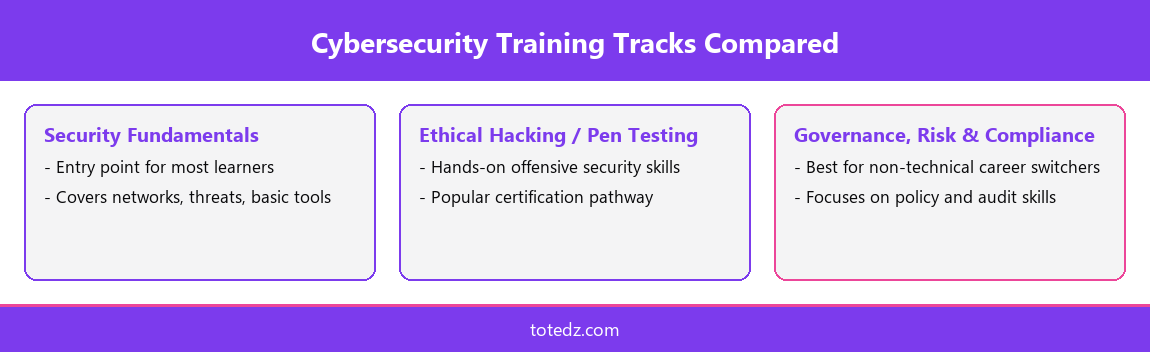
Cybersecurity training splits cleanly into three tracks with different entry requirements and different ideal candidates, shown below.
How to Choose Your First Track
If you already have some networking or systems administration background, security fundamentals followed by ethical hacking is the fastest path into a technical security role. If you are coming from a non-technical background, for instance audit, legal, or operations, governance and compliance training is usually a better entry point and tends to be underserved relative to demand in India right now.
Whichever track you choose, pair the course with a small, documented lab project. A basic vulnerability assessment on a deliberately vulnerable practice environment, written up clearly, does more for your first application than a longer list of course completions with nothing to show for them.
A less obvious factor worth weighing is how quickly each track lets you show competence publicly. Technical tracks often produce a portfolio-ready writeup within weeks. Governance and compliance skills are harder to demonstrate outside an actual workplace, which is one more reason to pair that track with an internship or a supervised project wherever possible.
If your interest in this field grew out of working with cloud infrastructure, our cloud computing career path guide covers the adjacent skill set, and our overview of data engineering skills and career outlook is useful if you are more drawn to the data-protection side of security than the offensive side.
Getting Guidance Before You Commit
A course-comparison page cannot tell you which track fits your existing background or which track has the strongest local hiring signal this year. A Totedz counselor reviews your history against the courses on the platform and helps you avoid starting with a track that does not match either your background or the market.
This is especially worth doing before you invest in a specialised, higher-cost certification, since switching tracks after paying for an advanced course is a far more expensive mistake than getting a second opinion first through a quick conversation with the team.
It also helps to be honest about time commitment before choosing a track. Technical tracks tend to demand more sustained weekly study hours to keep skills sharp, while governance tracks reward consistent but lighter study spread over a longer period, an important difference if you are studying alongside a full-time job.
Conclusion
Cybersecurity training rewards depth in one track over breadth across all three. Match the track to your existing background, whether that is technical or governance-focused, and prove the skill with one documented project before you apply anywhere. Browse cybersecurity courses on Totedz, or speak with a counselor to pick the right track first.
Frequently Asked Questions
Can I move into cybersecurity without a technical background?
Yes, particularly through governance, risk, and compliance roles, which value attention to detail and policy understanding as much as technical depth.
What is the fastest track into a technical security role?
Security fundamentals followed by ethical hacking or penetration testing training, ideally paired with a documented lab project on a practice environment.
Do I need a certification to get an entry-level cybersecurity job?
A recognised certification helps you pass initial screening, but a documented hands-on project usually matters more once you reach an actual interview.
How is governance and compliance training different from technical security training?
It focuses on policy, audit, and regulatory frameworks rather than hands-on system testing, and suits candidates from legal, audit, or operations backgrounds well.
Is India experiencing real demand for cybersecurity skills right now?
Yes, driven by growing digital infrastructure and stricter data protection expectations, with a particular shortage in mid-level governance and compliance roles.
How does a Totedz counselor help me pick a cybersecurity track?
A counselor reviews your background and target roles, then narrows your options to the track most likely to convert into a job, rather than the most popular one.