
Choosing a data science course is harder than it should be, mostly because nearly every listing claims to cover the same ground. This guide breaks the decision into four checkable criteria so you can compare options honestly instead of by marketing copy alone. For the wider tech skills picture beyond data specifically, see our complete AI and tech courses starting guide.
Curriculum Depth Comes Before Tool Count
A common shortcut in course marketing is listing every tool covered, Python, SQL, Tableau, sometimes a dozen names, as proof of thoroughness. Tool count says very little about depth. A program that spends real time on statistics fundamentals and data cleaning before introducing machine learning produces stronger graduates than one that rushes through basics to reach flashier modules faster.
Ask specifically how many weeks are spent on fundamentals versus advanced modeling before enrolling. A rough split of roughly 40 percent fundamentals is a reasonable minimum to expect from a beginner-oriented program.
It also helps to ask what happens when a learner struggles with a fundamentals module. Programs with genuine mentor support will slow down, offer a one on one session, or point to supplementary material. Programs built purely around pre-recorded video have no mechanism to do this at all, and a struggling learner simply falls further behind with each new module.
What a Fair Price Actually Buys
Data science course pricing in India varies enormously, from free introductory content to programs costing well over a lakh of rupees. Price alone tells you almost nothing about quality. The more useful question is what the price includes beyond video content: how many hours of live mentor time, how many project reviews, and whether placement support is genuinely active or a token line in the brochure.
A moderately priced program with two structured project reviews and responsive mentor access will usually outperform a more expensive program that offers neither, simply because the feedback loop is what converts watched content into usable skill.
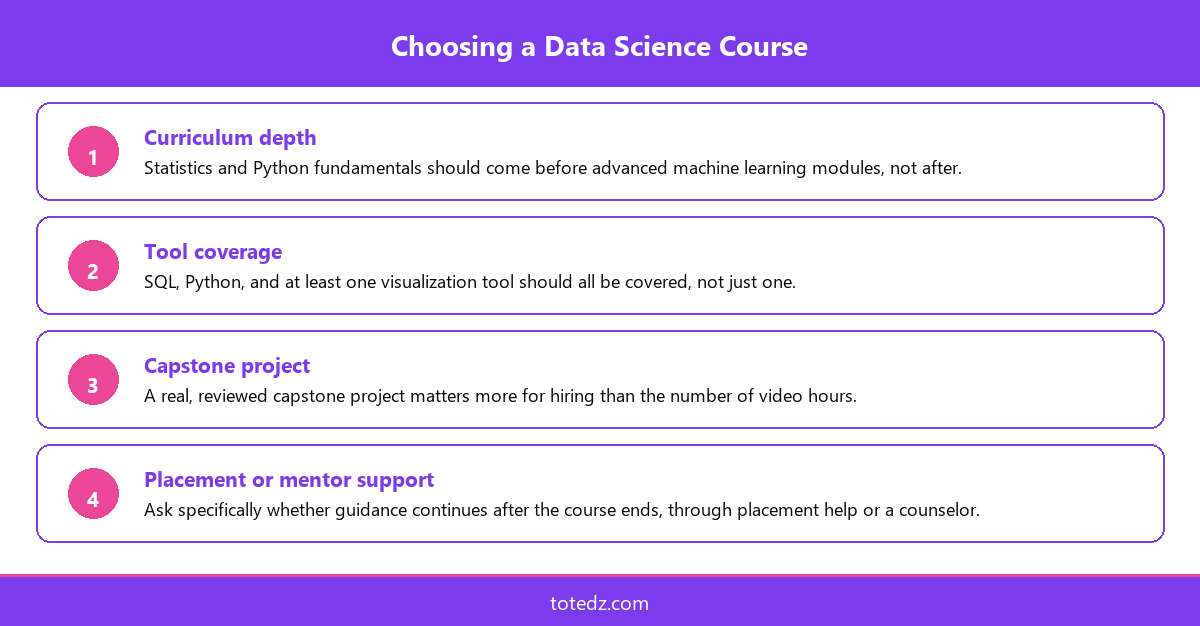
Four Checks at a Glance
Kerala's Growing Analytics Demand
Analytics hiring in Kerala has grown alongside the state's IT park expansion, particularly in Kochi's Infopark and Technopark corridors, though it still trails Bangalore and Hyderabad in raw volume. This means a data science course chosen locally should weigh SQL and business intelligence tooling heavily, since regional employers hire more frequently for reporting and analytics roles than for research-heavy machine learning positions.
Programs backed by Skill India initiatives have also started including analytics tracks, though depth varies significantly between providers, which is exactly why the criteria in this guide matter more than any single program's government affiliation.
Employers hiring locally also tend to value a candidate's familiarity with the specific reporting tools already used inside their own organisation, more often a spreadsheet-adjacent tool or a business intelligence dashboard than a research-grade statistical package. A course chosen for a Kerala job search should reflect this, even if it means trading some academic depth for practical, tool-specific fluency.
How a Totedz Counselor Helps You Decide
Two data science programs can look nearly identical on paper and differ enormously in mentor responsiveness, project review quality, and how graduates have actually fared afterward. A counselor who has tracked outcomes across multiple academy listings can point you toward the program that matches your specific starting point, rather than the one with the most polished landing page.
If your goal is closer to validating existing skills than building new ones from scratch, it is also worth reading how a full program compares to a shorter standalone certification exam, since the two serve different situations despite frequent overlap in marketing language.
This kind of comparison is exactly where a course catalog falls short and a counselor adds real value. A catalog page will describe what a course covers; it cannot tell you whether that coverage matches what a specific employer you are targeting actually screens for, which is often the more decisive question.
Four Criteria Worth Checking Before You Enroll
- Curriculum sequencing: fundamentals before advanced modeling, not the reverse.
- Tool coverage: SQL, a programming language, and at least one visualization tool, not just one of the three.
- Capstone project: a real, reviewed project using an actual dataset, not a templated exercise everyone submits identically.
- Ongoing support: confirm whether mentor access or placement guidance continues after the course technically ends.
A program that scores well on all four rarely needs to compete on price alone, and a program that scores poorly on more than one is worth skipping regardless of how it is priced.
It is worth writing these four criteria down before browsing course listings, rather than trying to hold them in mind while comparing several tabs at once. Marketing copy is specifically designed to make every program sound complete, and a short written checklist is a simple, effective defence against that framing.
Conclusion
The right data science course is the one that matches your starting point, covers fundamentals honestly, and ends in something you can show rather than just a certificate. Browse data and analytics courses on Totedz or speak with a counselor to compare specific programs against these criteria directly. If you are still comparing learning platforms in general before settling on a course, our guide to choosing an online learning platform covers that decision separately.
Frequently Asked Questions
What is the single most important factor when choosing a data science course?
Curriculum sequencing. A program that builds statistics and data handling fundamentals before advanced modeling produces far more capable graduates than one that rushes to impressive-sounding topics early.
Do I need a math background to start?
Basic comfort with numbers and logical thinking helps, but a well structured beginner program should teach the required statistics as part of the curriculum itself.
How long does a proper data science course usually take?
Three to five months for a thorough beginner to intermediate program studied part time, longer for programs that include an extensive capstone project phase.
Is an online masters in data science necessary to get hired?
Not for most entry level analytics roles in India. A strong project portfolio from a shorter, well structured program often carries more weight with regional employers than a full degree.
What is the difference between this and a data engineering track?
Data science focuses on analysis and modeling. A related but distinct path, building and maintaining data pipelines, is closer to engineering than analysis.
Can Totedz help me compare specific data science programs directly?
Yes, a counselor can review your goals against specific academy listings and outcomes data the platform tracks, which a course's own marketing page will not show you.